Almost everyone deciding between these two hears the same two claims. Korean is easier because of Hangul. Japanese is easier because the pronunciation is simpler. Both claims are partly right and both are misleading.
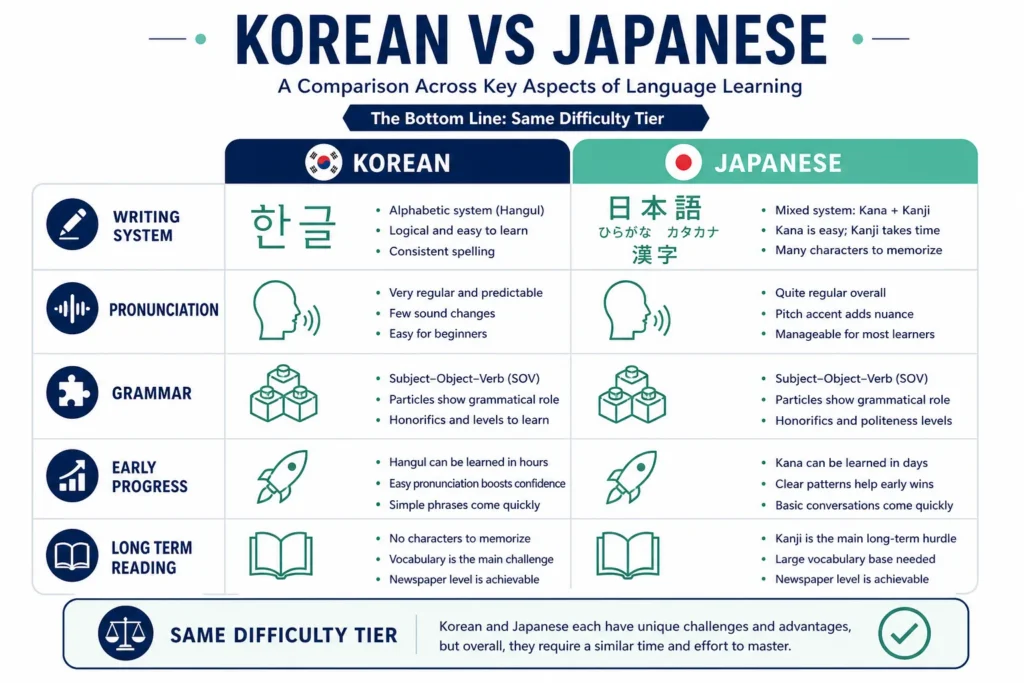
Official difficulty ratings put them in the same tier. So the choice is not about difficulty in the abstract. It is about which part of the difficulty you would rather face first.
They rank the same on paper
The Foreign Service Institute groups both Korean and Japanese into its hardest category for English speakers, alongside Mandarin, Cantonese and Arabic. The reference figure for both is around 88 weeks or 2,200 hours.
So if someone tells you one is dramatically easier than the other, they are describing their own experience, not a measured difference. The total cost is comparable. The order of pain is not.
Where they actually diverge
| Aspect | Korean | Japanese |
|---|---|---|
| Writing system | One alphabet, days to read | Two syllabaries plus about 2,100 standard kanji |
| Pronunciation | Harder. Similar consonants, batchim endings | Easier. Fewer sounds, more regular |
| Grammar | Verb-final, particles, speech levels | Verb-final, particles, keigo |
| Early progress | Fast. You can read week one | Slow. Reading real text takes months |
| Long-term reading | Vocabulary is the barrier | Kanji remains a barrier for years |
The grammar row is the surprise. The two languages are structurally similar — both put verbs last, both mark grammar with particles, both encode social hierarchy in verb endings. Learners who study one often find the other’s grammar familiar.
So the honest framing is: the grammar difficulty is nearly shared, and the writing systems are where they split.
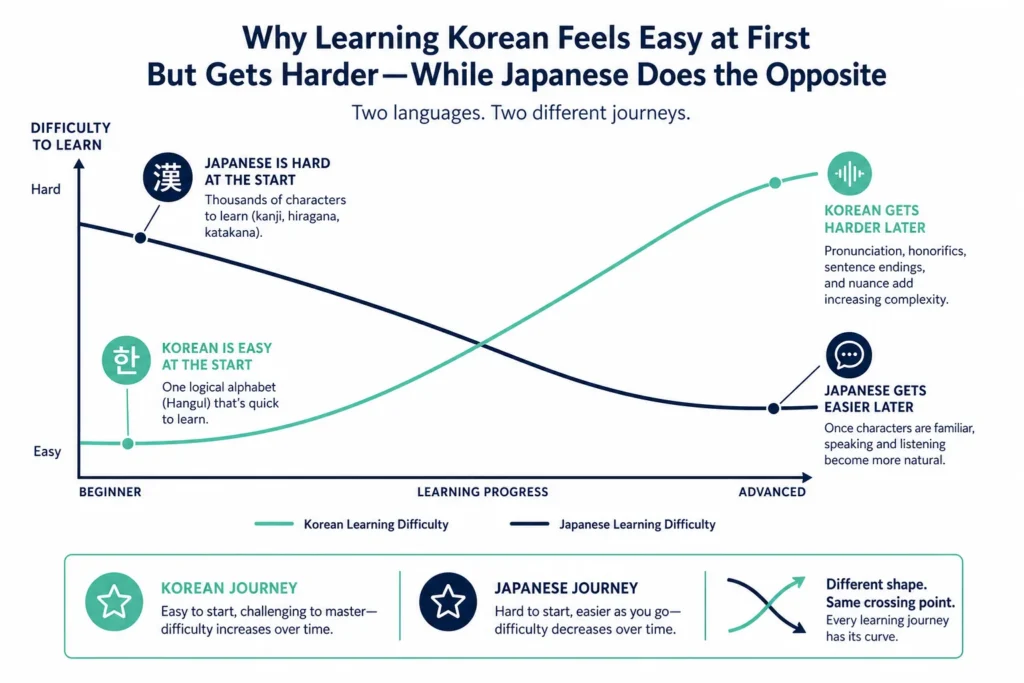
Korean punishes you later, Japanese punishes you first
This is the cleanest way to think about it.
With Korean, week one feels like a win. You read signs, you decode names, you feel progress. Then pronunciation and listening turn out to be genuinely hard, because several consonants sound nearly identical to an untrained ear and syllable-final consonants change how words connect.
With Japanese, week one is slow. Two syllabaries first, then kanji forever. But once you speak, people understand you, because the sound inventory is small and regular.
Choose by what you want to do with it
- Watch and listen to media — Korean gets you to useful listening sooner
- Read novels, games, manga — Japanese demands kanji, so budget for it deliberately
- Travel and short trips — Korean’s fast reading start is a practical advantage
- Live and work long-term — both require the full climb, so pick by where you will actually be
The single worst reason to choose is “whichever is easier.” Motivation carries you further than a marginal difficulty difference, and at 2,200 hours the thing that decides success is whether you still care in year two.
Can you study both at once?
It is possible but usually a bad trade early on. The grammatical similarity that helps later becomes interference at the start, because parallel structures with different particles blur together.
A more reliable order is to take one to solid intermediate first, then add the second. At that point the shared structure genuinely accelerates the second language instead of confusing the first.
The bottom line
Same tier, same hour estimate, different order of difficulty. Korean gives you an early reading win and charges you later in pronunciation. Japanese charges you upfront in writing and rewards you with easier speech. Pick the media and the country you actually care about.
Korean vs Japanese: common questions
Is Korean grammar easier than Japanese grammar?
They are structurally close. Both are verb-final, both use particles, both encode politeness in verb endings. Learners rarely find one dramatically easier than the other at the grammar level.
Does knowing one help with the other?
Yes, at intermediate level and beyond. Sentence structure and honorific logic transfer well. Vocabulary transfers partly through shared Chinese-derived roots, though pronunciation differs.
Which has easier pronunciation for English speakers?
Japanese, generally. It has a smaller sound inventory and more regular syllable structure. Korean has consonant distinctions that take deliberate training to hear and produce.
How many kanji do I actually need?
The standard list used in Japanese education contains roughly 2,100 characters. Functional reading of everyday material needs a large share of that, which is why the writing system dominates the early years.