
You watched a drama without subtitles for three minutes and understood almost nothing. Then someone told you Hangul takes a weekend. Both things are true, and that is exactly what makes the timeline confusing.
The alphabet is genuinely fast. The language is not. Here is the honest split.
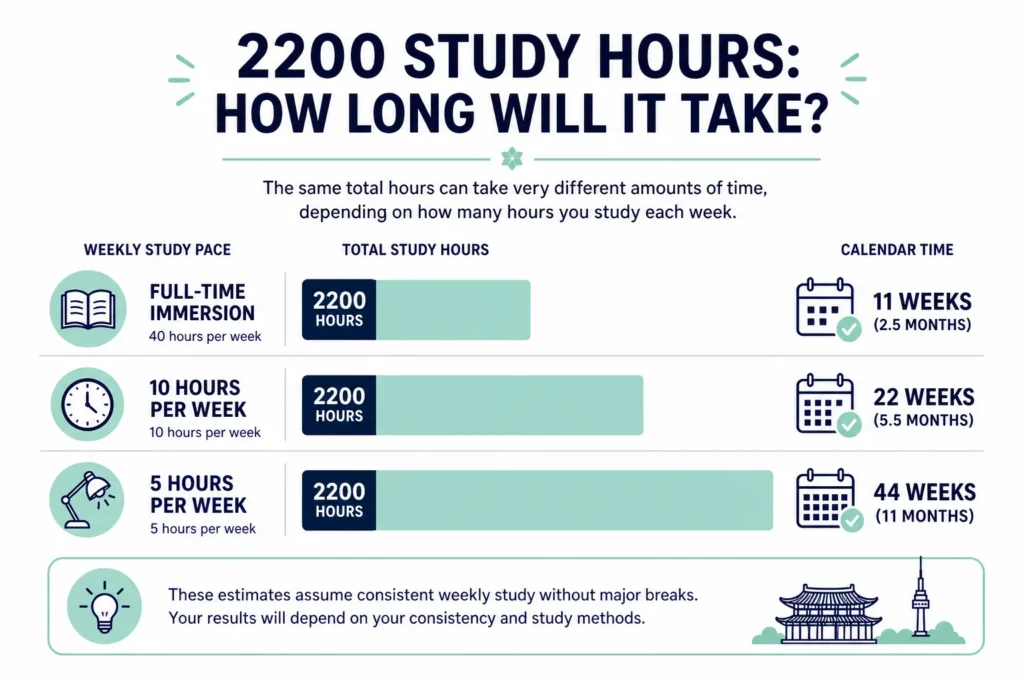
What 2,200 hours actually looks like
That number comes from full-time diplomatic training. Translating it into a normal life is the part nobody does for you.
| Study pace | Time to 2,200 hours | Realistic for |
|---|---|---|
| 25 hours a week (full-time) | About 88 weeks | Immersion programs |
| 10 hours a week | Roughly 4 years | Serious hobbyist |
| 5 hours a week | Roughly 8 years | Most self-learners |
| 1 hour a week | Decades | Not a path to fluency |
The table is not meant to discourage you. It is meant to separate fluency from usefulness. Professional proficiency is a very high bar. Ordering food, following a variety show, or texting a friend arrives far earlier.
Hangul is the one genuinely easy part
Korean’s writing system was designed to be learned quickly, and it shows. Most people can read Hangul aloud within a few days of focused practice.
- 14 basic consonants and 10 basic vowels — combined into syllable blocks
- Mostly phonetic — what you see maps closely to what you say
- No characters to memorize — unlike Chinese or Japanese kanji
This is why the early days feel encouraging and week six feels brutal. You finish the alphabet and then meet the grammar.
Where the difficulty actually sits
Three things make Korean slow for English speakers, and none of them is the alphabet.
- Word order — verbs land at the end, so you cannot translate in real time as you listen
- Speech levels — the same sentence changes shape depending on who you are talking to
- Particles — small markers that carry the grammar English handles with word position
Speech levels are the one that surprises people. It is not just polite versus casual. Using the wrong level with the wrong person is a social error, not a grammar error, and textbooks rarely teach the judgment part.
Milestones that arrive much sooner
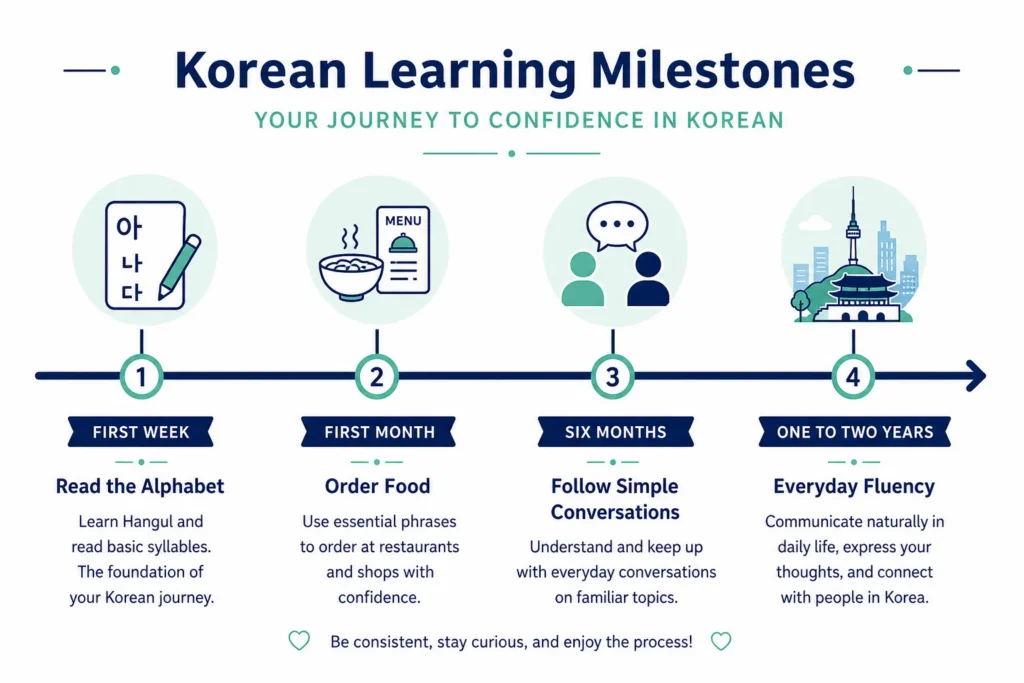
Fluency is the wrong first goal. These are the checkpoints that actually keep people going.
- Week 1 — read Hangul aloud, even without understanding
- Month 1 — order food, read menus and signs, handle basic greetings
- Month 6 — follow simple conversations with context, recognize drama phrases
- Year 1 to 2 — hold everyday conversations, read with a dictionary
- Beyond — news, workplace Korean, nuance and humor
Notice how much sits inside the first month. The gap between zero and useful is small. The gap between useful and fluent is enormous.
What makes people faster
Two habits show up consistently in people who progress and are missing in people who stall.
The first is daily contact over long sessions. Twenty minutes every day beats three hours on Sunday, because vocabulary decays fast.
The second is output early. Reading and listening feel productive but build recognition only. Speaking and writing force retrieval, which is what turns recognition into recall. If you have watched fifty hours of drama and still cannot form a sentence, this is why.
The bottom line
Plan for years, not months, if fluency is the target. But expect real usefulness inside the first month, because Hangul and survival phrases come cheap. The comparison people ask about next is whether Japanese would be easier, and the answer is not what most expect.
Learning Korean: common questions
Can I learn Korean in a year?
You can reach comfortable everyday conversation in a year with consistent daily study. Professional proficiency in a year is not realistic for most people, since the reference figure is around 2,200 hours of instruction.
Is Hangul really learnable in a weekend?
Reading it aloud, largely yes. Reading it fluently and hearing the difference between similar consonants takes longer. The claim is true about decoding, not about comprehension.
Do I need a teacher or will apps do?
Apps handle vocabulary and reading well. They handle speech levels and pronunciation feedback poorly. Most learners plateau at the point where they need someone to correct output rather than deliver input.
Does watching K-dramas count as study?
It builds listening familiarity and vocabulary in context, which is real value. It does not build production. Treat it as one input channel alongside deliberate practice, not as a replacement.