
You followed a ten-step routine you saw online and your skin got worse. That is a common outcome, and it is not because the products were bad.
Most routine guides are written for one skin type and presented as universal. The step order barely changes between types. What changes is texture and frequency. That distinction is the whole point.
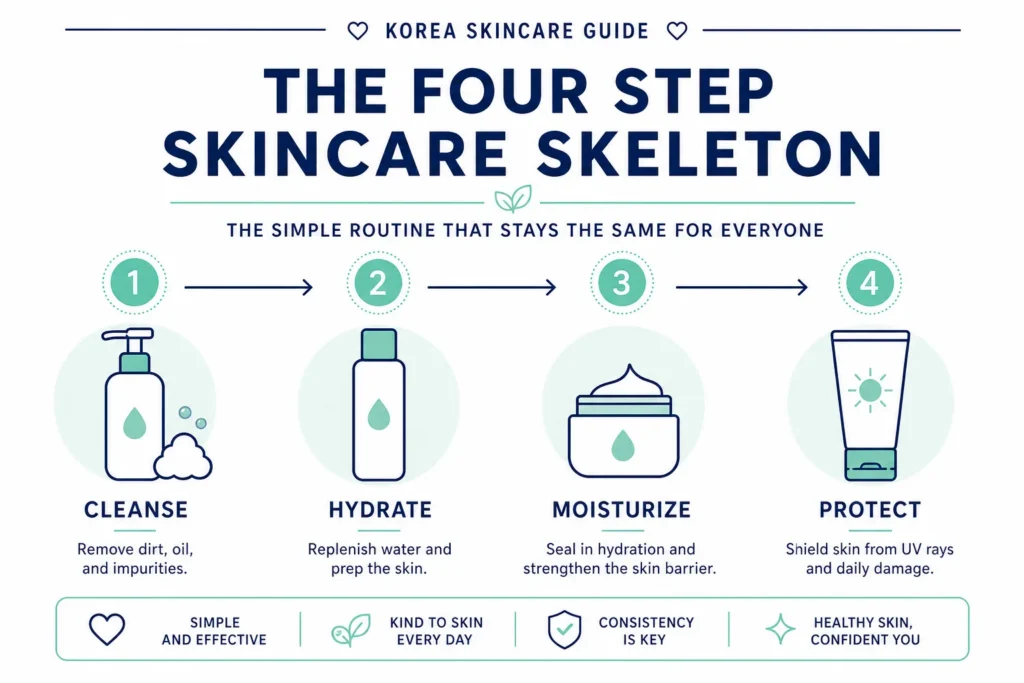
The skeleton that stays the same
Before splitting by type, this is the core that applies to everyone.
- Cleanse — remove sunscreen and makeup, then wash
- Hydrate — a watery layer to put moisture in
- Moisturize — a layer to keep that moisture from leaving
- Protect — sunscreen every morning, without exceptions
Everything else is optional. The famous ten-step lists are that skeleton with extras stacked on top. Adding steps is a choice, not a requirement.
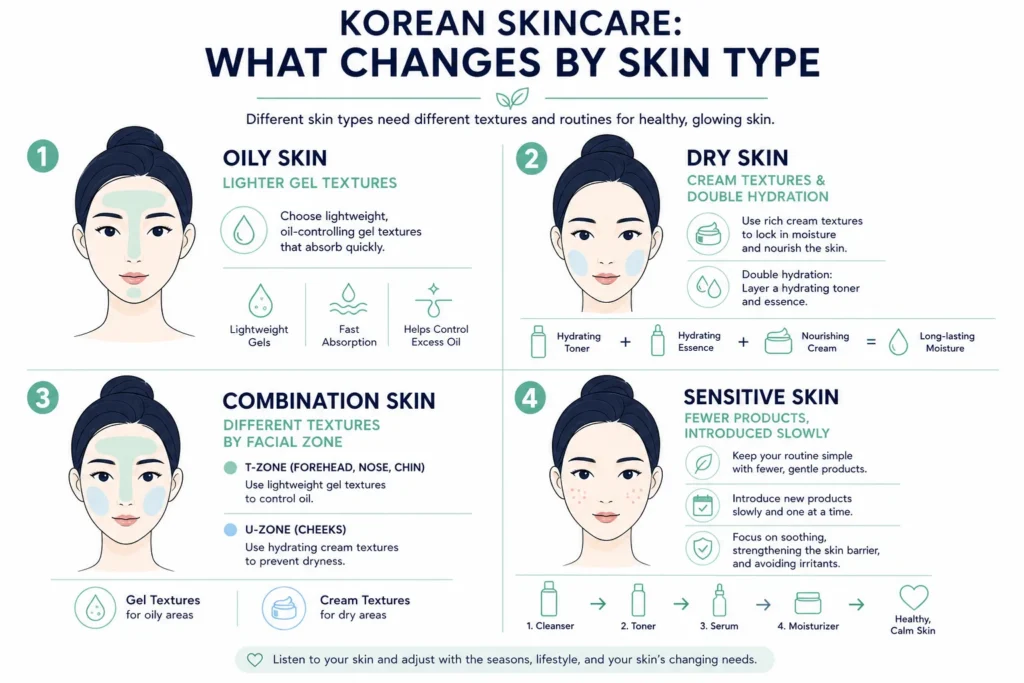
What changes by skin type
| Skin type | Adjust | Avoid |
|---|---|---|
| Oily | Gel or lotion textures, lighter layers | Heavy creams, over-washing |
| Dry | Cream textures, layer hydration twice | Foaming cleansers that squeak |
| Combination | Different textures by zone | Treating the whole face as one |
| Sensitive | Fewer products, introduce one at a time | Fragrance, acids and retinoids stacked together |
The combination row is the one people resist. Applying a light gel on the T-zone and a cream on the cheeks feels fussy, but combination skin is literally two skin types on one face. One product cannot serve both.
Oily skin: the counterintuitive part
The instinct is to strip oil. Harsh cleansers, astringent toners, skipping moisturizer. This usually makes oil production worse, because a damaged barrier compensates by producing more.
What tends to work instead is gentle cleansing plus light hydration. Gel moisturizers give the barrier what it needs without a heavy film. Oily skin still needs moisture; it just does not need occlusion.
The other frequent error is over-exfoliating. Twice a week is plenty for most people, and daily acid use is where irritation starts.
Dry skin: layer, do not just thicken
The reflex is to buy a richer cream. That helps with sealing but does not add water. If the skin has nothing to seal in, a heavy cream sits on top and the tightness returns.
The more effective order is water first, then oil. A hydrating layer applied to slightly damp skin, then a cream over it. Two thin hydrating layers beat one thick one.
Cleanser choice matters more for dry skin than any other type. If your face feels tight and squeaky after washing, the cleanser is too strong regardless of what comes after.
Sensitive skin: subtract before you add
Sensitive skin is the type most damaged by long routines. Every additional product is another variable, and when a reaction happens you cannot tell which one caused it.
- Start with four steps — cleanser, hydrating layer, moisturizer, sunscreen
- Add one product at a time and wait one to two weeks
- Patch test on the jawline before the full face
- Stop at stinging — tingling is not a sign of working
That last line deserves emphasis. A product that stings is irritating your barrier, not activating it.
Identify your type honestly first
A simple check: wash your face, apply nothing, and wait an hour.
- Shine everywhere — oily
- Tight everywhere — dry
- Shiny T-zone, tight cheeks — combination
- Redness or itching regardless — sensitive, possibly alongside another type
Sensitive is not a fifth alternative. It can sit on top of any of the other three, which is why “sensitive dry skin” and “sensitive oily skin” both exist and need different textures.
The bottom line
Keep the four-step skeleton and change the texture, not the order. Oily skin needs hydration without heaviness, dry skin needs water before oil, combination skin needs two textures, and sensitive skin needs fewer products introduced slowly. Anything that stings comes out.
Korean skincare by skin type: common questions
Does oily skin need moisturizer?
Yes. Skipping it often increases oil production because the barrier compensates. The fix is texture, not omission — a gel or light lotion instead of a rich cream.
How many steps should I actually use?
Four is a complete routine: cleanse, hydrate, moisturize, protect. Extra steps are optional additions for specific concerns, not requirements for healthy skin.
Can I use different products on different parts of my face?
Yes, and for combination skin it is usually the better approach. A lighter texture on the T-zone and a richer one on dry areas addresses both without compromising.
How long before I know a product works?
Hydration effects show within days, but barrier and texture changes take four to six weeks. Introduce one product at a time so you can attribute any change to the right source.