The stalls all look approachable until you are standing in front of one with a queue behind you and no idea what you are pointing at. Menus are often handwritten, in Korean, with no prices.
The good news is that the price range is narrow and predictable. Most single items sit between 1,000 and 4,000 won. Knowing that turns the whole thing from a gamble into a menu.
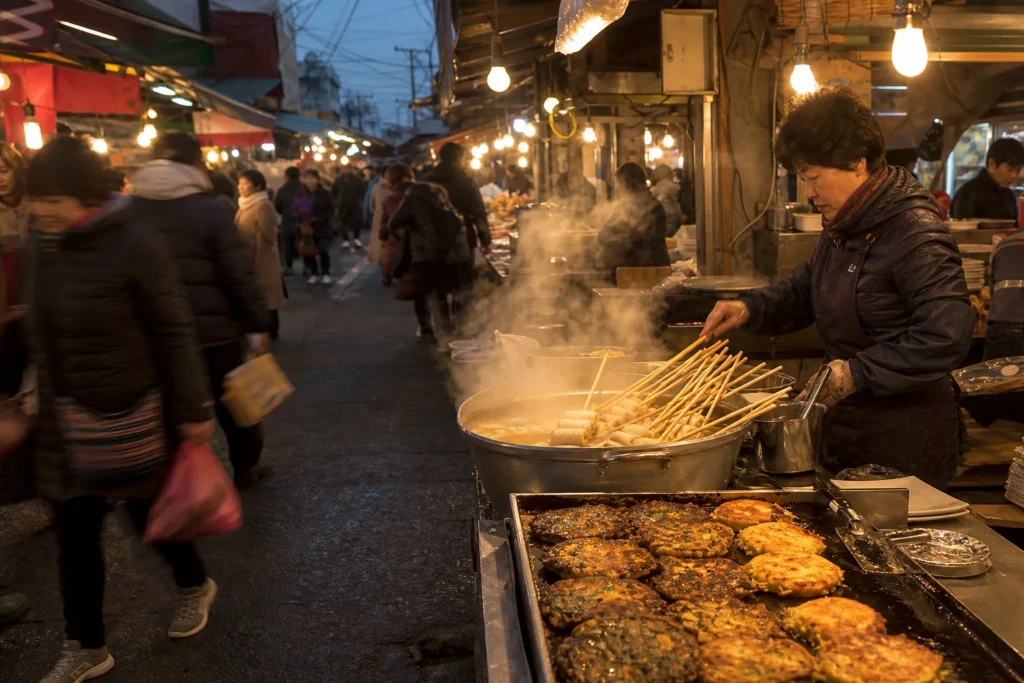
The core dishes and what they cost
| Dish | Typical price | What to expect |
|---|---|---|
| Tteokbokki | 3,000 ~ 5,000 won | Chewy rice cakes in sweet-spicy sauce. The default order |
| Hotteok | 1,000 ~ 2,000 won | Fried pancake with molten brown sugar and nuts. Winter staple |
| Bungeoppang | 1,000 ~ 2,000 won | Fish-shaped cake filled with red bean. Sold in small bags |
| Eomuk | 1,000 ~ 2,000 won per skewer | Fish cake on a stick, with free broth from the pot |
| Gimbap | 3,000 ~ 4,000 won | Seaweed rice roll. The most portable option |
Two practical notes. First, the eomuk broth is usually free and served in a paper cup — take it, especially in winter. Second, tteokbokki portions vary wildly between stalls, so the price spread reflects size more than quality.
Location changes the price more than quality does
This is the single most useful thing to know. The same dish costs very different amounts depending on the street.
Reports put tteokbokki around 8,000 won on the busiest tourist corridors and about 3,500 won at Gwangjang Market. Same dish, different postcode. Stepping one or two streets off the main strip commonly cuts 20 to 30 percent.
Myeongdong is the clearest example. It is convenient and English-friendly, and you pay for both. Traditional markets are cheaper, busier and more interesting, and the vendors have been making one thing for decades.
How ordering actually works
The mechanics differ from a restaurant and that is where most confusion comes from.
- Point and hold up fingers — this is normal and nobody minds
- Pay when you receive, not when you order, at most stalls
- Cash still helps — many stalls take cards, but small ones may not
- Eat near the stall — walking while eating is uncommon and some vendors expect you to finish there
The last point trips up visitors. There is often a narrow standing counter. Using it is the expected behavior, not an inconvenience.
Seasonality is real
Some items are not available year-round, and looking for them out of season is a wasted search.
- Winter — hotteok, bungeoppang, roasted chestnuts, steamed eggs
- Year-round — tteokbokki, gimbap, eomuk, fried snacks
- Summer — cold noodles and shaved ice move to the front
Bungeoppang in particular has become a winter-only ritual with its own following. Locals track which stalls have opened for the season.
If you only have one hour
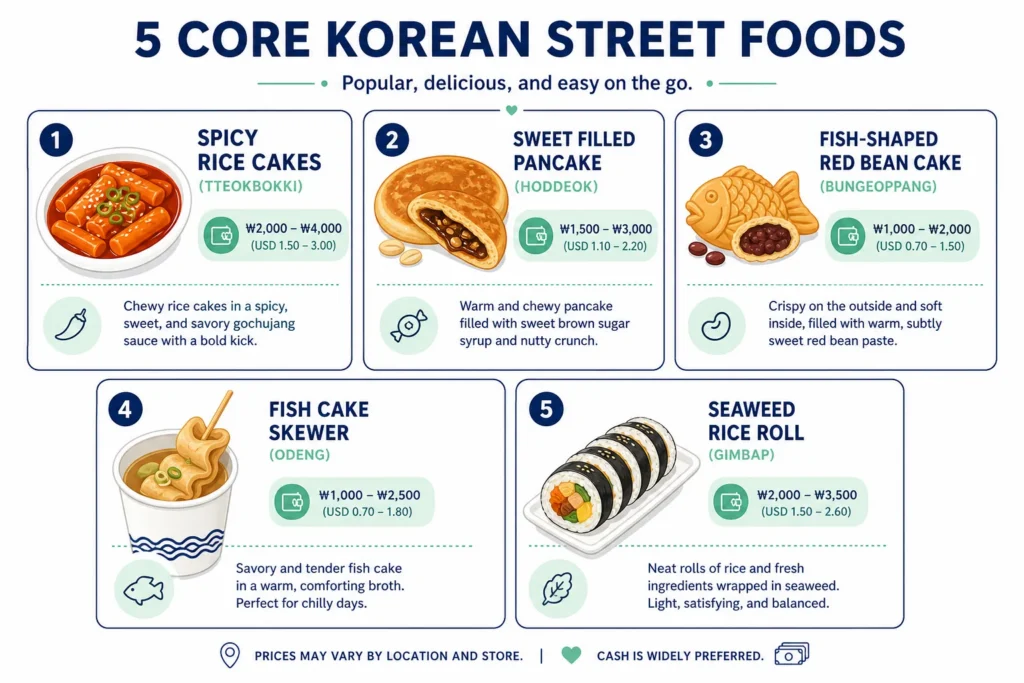
Go to a traditional market rather than a tourist street, and order three things: one spicy, one savory, one sweet. That covers the range without overcommitting.
A workable set is tteokbokki, an eomuk skewer with broth, and hotteok. Total cost lands well under 10,000 won, and you will have tasted the three flavor profiles that define the category.
The bottom line
Individual items are 1,000 to 4,000 won and a full tasting run fits in 20,000 to 30,000 won. Location matters more than quality for price, so walk off the main strip. Take the free broth, pay on receipt, and eat at the stall.
Korean street food: common questions
Is Korean street food safe to eat?
Stalls are subject to hygiene rules and high turnover keeps food fresh. As anywhere, pick busy stalls where food is cooked to order rather than sitting out. Fried and boiled items carry the least risk.
Can I find non-spicy options?
Yes. Gimbap, eomuk, hotteok, bungeoppang and most fried items are mild. Tteokbokki is the main spicy staple, and some stalls offer a soy-based version instead of the red sauce.
Do stalls take cards or mobile payment?
Many do, especially in busy areas. Smaller and older stalls may be cash only. Carrying some small bills avoids the awkward moment at the front of a queue.
Which market should a first-timer choose?
A large traditional market gives the widest range in one place and prices well below tourist streets. Check opening hours before going, since market food alleys often wind down earlier than you expect.