You have watched hundreds of hours of Korean content. You recognize dozens of phrases. And you still cannot build a sentence on your own.
That is not a failure of effort. It is a predictable result of how media input works. Media builds recognition. It does not build production. Once you know that, it becomes a useful tool instead of a comfortable substitute for studying.
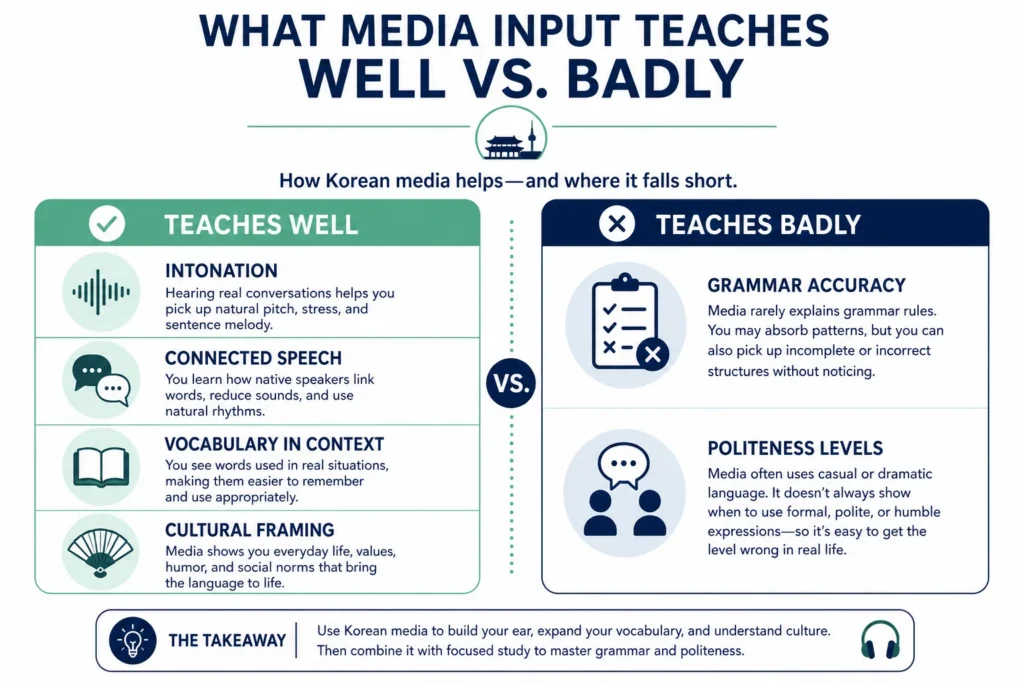
What media genuinely teaches well
- Prosody — where sentences rise and fall, which textbooks cannot convey
- Connected speech — how endings blur together in real speed
- Vocabulary in context — words attached to situations, which sticks better than lists
- Cultural framing — when people bow, hedge, or switch register
That last one is underrated. You will absorb when a character suddenly switches to formal speech and why the room goes quiet. No grammar table conveys that.
What it teaches badly
| Source | Distortion | Risk |
|---|---|---|
| Song lyrics | Grammar bent for meter and rhyme | Learning structures nobody says |
| Romance dramas | Heavy casual speech between leads | Using casual forms with strangers |
| Historical dramas | Archaic vocabulary and endings | Sounding like a period drama |
| Variety shows | Slang with a short shelf life | Dated expressions |
The second row causes the most real-world trouble. Drama couples speak in intimate forms because they are intimate. Copying that with a coworker or a shop clerk lands badly. The words are correct; the level is wrong.
A method that actually converts watching into learning
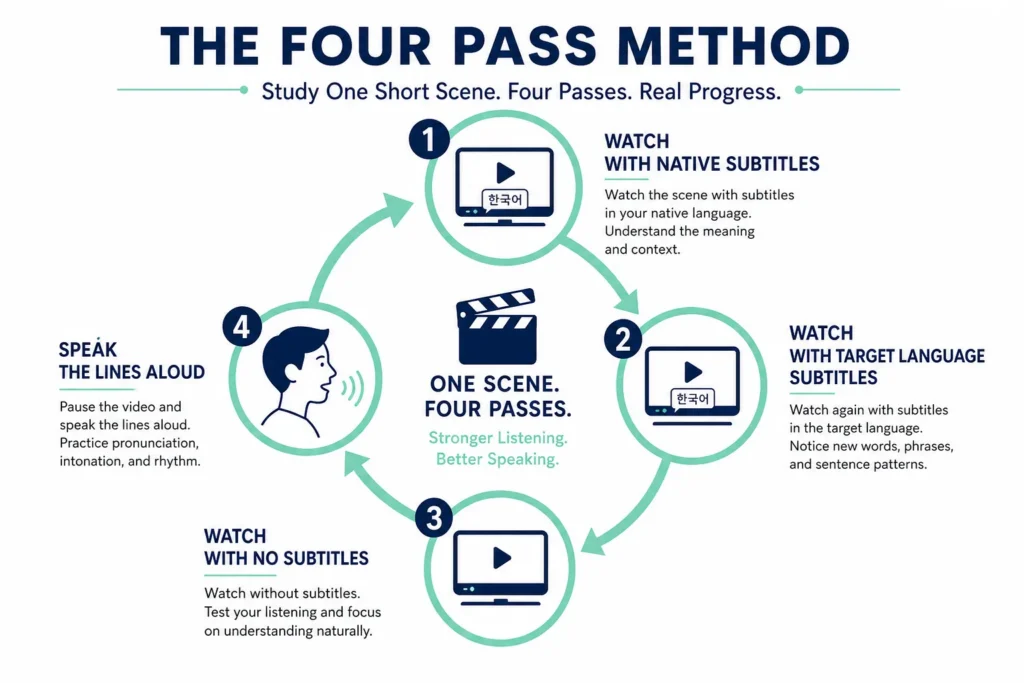
The difference between passive viewing and study is one extra pass. Pick a short scene, not a whole episode.
- Pass 1 — watch with English subtitles. Get the meaning
- Pass 2 — watch with Korean subtitles. Match sound to spelling
- Pass 3 — no subtitles. Notice what you now catch
- Pass 4 — say the lines out loud, copying the intonation
Pass four is the one people skip, and it is the one that builds production. Two minutes of scene, four passes, ten minutes total. That beats an hour of passive watching.
Songs are for sound, not for grammar
Lyrics are compressed and rearranged to fit music. Particles get dropped, word order shifts, endings get clipped. Treating a chorus as a grammar model teaches you patterns that native speakers do not use in conversation.
Where songs do help is pronunciation and memory. Melody makes vocabulary stick, and singing along trains your mouth on Korean sound sequences. Use them for that, then verify the grammar elsewhere.
Pick content by difficulty, not by preference
Not all shows are equally usable at the same level.
- Easier — slice-of-life and romance set in the present day, everyday settings
- Harder — legal, medical and crime dramas, dense with jargon
- Hardest — historical dramas, with archaic forms and titles
- Variable — variety shows, fast and full of in-jokes but rich in real speech
Starting with a period drama because you love the genre is a common way to stall. Save it as a reward for later.
The bottom line
Media is excellent input and terrible curriculum. Use it for listening, rhythm and context, and get grammar and politeness levels from a structured source. Add one speaking pass to every scene you study, and the hours you already enjoy start producing output.
Learning Korean from media: common questions
Should I use Korean subtitles or none at all?
Both, in sequence. Korean subtitles bridge sound and spelling, which is where most listening gains come from. Watching with no subtitles too early mostly trains you to guess from visuals.
Can I get fluent from dramas alone?
Not on their own. You will build strong listening comprehension and a large passive vocabulary, but production and grammar accuracy need deliberate practice and correction.
Which drama genre is best for beginners?
Contemporary slice-of-life and light romance. The vocabulary is everyday, the settings are familiar, and the speech is closer to what you will actually use.
Is it a problem that idols speak casually in videos?
Only if you copy the level without noticing it. Casual forms are correct Korean used in the right relationships. The skill to develop is recognizing which level fits which person.