Some casting news matters because of who is in it. This one matters because of where it is happening. The Apartment Job marks Ji Sung making his official Netflix debut — an actor with a long broadcast career moving onto a streaming platform for the first time.
That shift says something about where Korean television is going, and it is worth unpacking.
What is confirmed
- Lead — Ji Sung
- Platform — Netflix
- Significance — his official Netflix debut
We are not listing plot details, episode counts or supporting cast here. Those figures for upcoming and recent titles are frequently wrong in aggregated coverage, and a confident number from an unreliable source is worse than an honest gap.
Why a veteran actor moving to Netflix matters
Access changes for international viewers
This is the practical part. Korean dramas that air on domestic broadcasters reach international audiences through a patchwork of licensing deals. Depending on where you live, a well-regarded series can be simply unavailable, or scattered across services you do not subscribe to.
A Netflix original removes that. When an actor with a substantial broadcast body of work makes a Netflix project, a whole audience gets access to them for the first time.
Different production constraints
Broadcast and streaming impose different limits. Episode counts, content restrictions, and release patterns all shift. For an actor who has spent a career in one system, the change is not just a different employer — it is a different set of possibilities for the kind of role available.
A signal about the industry
The direction of travel in Korean television has been clear for several years. What is notable now is that established broadcast talent is following, not just new faces. That tends to raise the average quality of the streaming slate rather than just its volume.
Where to watch
| Item | Detail |
|---|---|
| Platform | Netflix |
| Region availability | Broad, as a Netflix release |
| Subtitles | Multiple languages |
| Recommended mode | Korean audio with subtitles |
Why apartments keep showing up in Korean drama
If the title makes you wonder why so many Korean stories revolve around apartment buildings, there is a reason worth knowing.
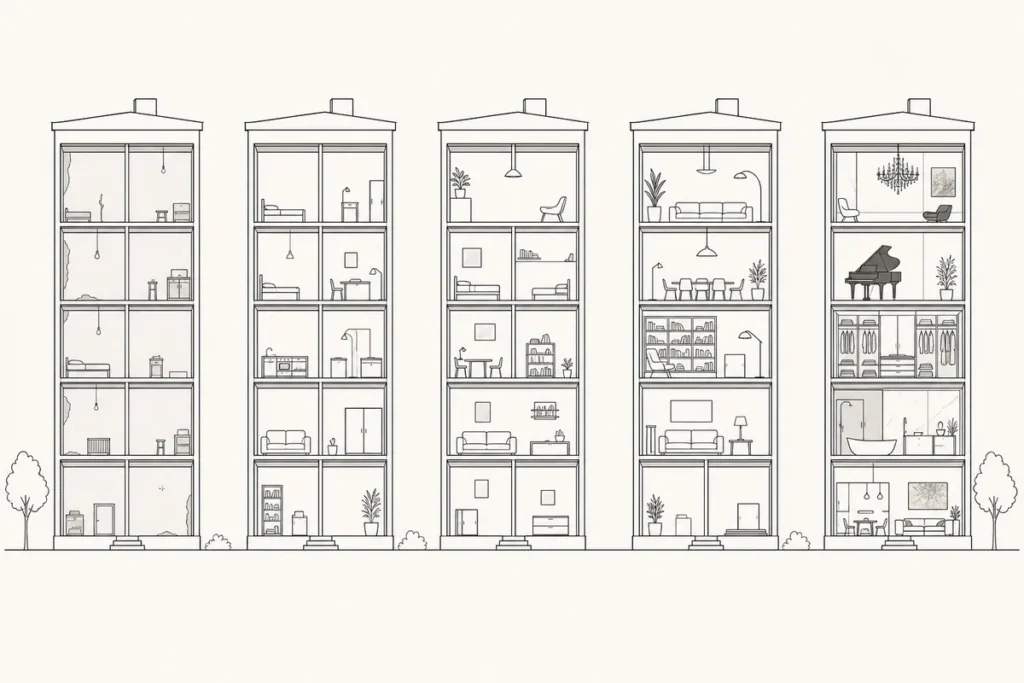
Apartment complexes are where most urban Koreans live, and they concentrate a lot of social pressure into one physical space: property values, neighbour hierarchies, school districts, noise disputes, and the visible gap between buildings that look identical from outside. An apartment complex is a closed system with clear rules and unequal outcomes, which makes it useful for drama in the same way a boarding school or a corporate office is.
For international viewers, this is one of the few areas where a little context genuinely helps. The setting is not incidental — it carries meaning that a Korean audience reads immediately.
Spoiler boundary
No plot developments are discussed below. We are covering context and access only.
What to expect from the format
- Episode length — Korean episodes commonly run 60 to 70 minutes, longer than most Western streaming series
- Complete season design — most Korean dramas resolve fully in one season
- Front-loaded setup — the first two episodes usually establish before accelerating
That last point is the most common reason international viewers abandon a Korean drama early. If the opening feels slow, the standard advice to watch three episodes before judging is genuinely good advice for this format.
Following an actor rather than a genre
For viewers who have watched enough Korean drama to have preferences, following actors becomes more reliable than following genres. Genre labels in Korean television are loose — a series marketed as romance can spend half its runtime on a workplace thriller.
Actors are more consistent. They tend to choose projects with a recognisable centre of gravity, and a veteran with a long filmography gives you a lot of signal about what a new project is likely to be.
Where to go next
If the appeal here is a veteran performance in a contained setting, the recent Korean thriller and mystery slate is the closest match. If it is the apartment setting specifically, there is a whole strand of Korean drama built on residential space and class friction that is worth exploring.
Broadcast and streaming in Korea: what actually changed
The significance of a veteran actor moving to Netflix is hard to see without knowing the two systems.
| Aspect | Korean broadcast | Streaming original |
|---|---|---|
| Episode count | Often 16, sometimes far more | Frequently shorter, 6 to 12 |
| Release pattern | Two episodes weekly | Weekly or full drop, varies |
| Content latitude | Broadcast standards apply | Wider range permitted |
| Production schedule | Historically filmed while airing | Usually completed before release |
| International access | Region-by-region licensing | Available platform-wide |
The fourth row matters more than it looks. Filming while broadcasting meant scripts could react to audience response mid-run — and also meant punishing schedules. A completed production before release changes what kind of performance is possible, because an actor knows the whole arc while filming it.
How to find a Korean actor back catalogue
If a performance makes you want more from the same actor, this is where international viewers hit a wall. A few practical routes.
- Check the platform first — search the actor name on your streaming service. Netflix has licensed a portion of older broadcast dramas in many regions
- Expect gaps — a well-known drama from a decade ago may be unavailable in your country entirely. This is licensing, not obscurity
- Regional services — Korean-focused platforms carry catalogues that general services do not, with varying regional coverage
- Watch for remakes — some acclaimed Korean dramas are easier to find as later remakes in other countries, though the original is usually the stronger version
Why residential setting stories keep working
Beyond the practical points already covered, there is a structural reason apartment-set Korean dramas recur.
A closed cast with forced contact
Neighbours cannot avoid each other, which does the same job forced proximity does in romance. The setting generates scenes without requiring contrivance.
Visible inequality inside apparent sameness
Units in the same building can differ enormously in value and in the lives inside them, while looking identical from outside. That gap is inherently dramatic and it is legible to any audience, Korean or not.
Property as the central financial fact
For many Korean households the apartment is the single largest asset and the main axis of financial anxiety. A story set there is automatically a story about money, class and family expectation without having to announce it.
This is why the setting is not a coincidence across many Korean series. It is one of the few environments that carries plot, theme and social commentary at the same time.
The Apartment Job: frequently asked questions
Is this Ji Sung first streaming project?
It is described as his official Netflix debut. He has a substantial career in Korean broadcast television, which is why the platform move drew attention.
Do I need to know anything about Korean housing to follow it?
Not to follow the plot. Some social meaning attached to apartment complexes and property value will land more strongly for a Korean audience, but the story will not depend on you catching it.
Where can I watch his earlier work?
Availability varies considerably by region because broadcast dramas are licensed separately. Some titles appear on Netflix, others on regional streaming services or not at all in a given country.
How many episodes will there be?
We are not stating a count because pre-release figures are often revised. The Netflix title page is the reliable source once the series is listed.