Think of the song that plays when the leads finally meet in the rain. Someone wrote it. For five years, the question of what that person gets paid when the scene streams worldwide had no settled answer in Korea.
It does now.
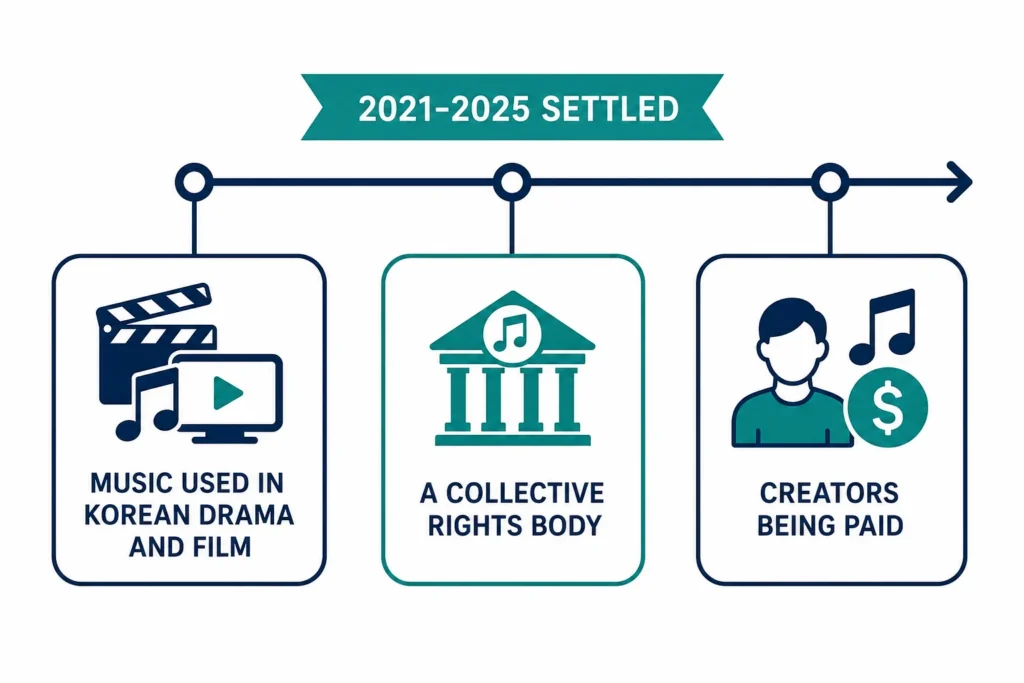
The Korea Music Copyright Association (KOMCA) and Netflix have signed a new music licensing agreement.
Netflix has paid music usage fees covering 2021 through 2025 in full — five years of back payments.
The settlement covers music used in Korean films, dramas and animation distributed at home and abroad.
What was actually stuck
Music in a drama is not covered by the same licence as the drama itself. Composers, lyricists and publishers hold separate rights, and in Korea those are administered collectively through KOMCA.
When streaming platforms distribute a Korean drama internationally, the music inside it travels too. Working out what that is worth — and on what basis it should be calculated — is where the disagreement sat.
The result was a five-year gap. Korean content went global. The accounting for its music did not keep up.
Why five years is the number that matters
2021 to 2025 is not an arbitrary window. It covers the period in which Korean content became a global default rather than a niche interest.
| During the gap | After the agreement | |
|---|---|---|
| Korean content abroad | Expanding rapidly | Same |
| Music travelling with it | Yes | Yes |
| Settlement mechanism | Unresolved | Agreed |
| Back payments | Accumulating | Paid in full |
In other words, the music that helped make those scenes memorable was being consumed globally throughout the exact period when the payment framework was unsettled. Clearing it retroactively is the substance of this deal.
The part that is not solved
This agreement covers Netflix. It does not cover everyone.
Korean domestic streaming platforms have their own arrangements, and industry commentary following the announcement pointed directly at them as the remaining question. One global platform settling does not automatically set terms for the rest of the market — but it does establish a reference point.
There is also a separate, broader argument running in parallel. A coalition of Korean creators met with the National Assembly Speaker in late August, arguing that the money flowing into K-content is not reaching the people who make it. Their position was blunt: the ecosystem collapses if this continues.
Those are two different problems. Collective music licensing is a mechanism question. Creator revenue share is a contract question. This deal addresses the first.
Does this change anything for viewers?
Not directly, and it is worth being honest about that. Nothing about your subscription or catalogue changes because of a royalty settlement.
What it affects is upstream. When the payment path for drama music is unclear, the rational response from production is to use less music, use cheaper music, or use music whose rights are simpler to clear. A settled framework removes that pressure.
If you have ever noticed that a K-drama OST can carry a scene almost by itself, that is a budget decision as much as an artistic one — and budget decisions follow from whether the money is predictable.
Why international fans should care
- OSTs are part of why K-drama travels. Soundtracks routinely chart independently of the shows they came from
- The people writing them are mostly invisible. Composer credits rarely surface the way actor and director credits do
- Global distribution created the problem. A domestic-only broadcast has simple music accounting; worldwide streaming does not
In short
Netflix and KOMCA have settled five years of Korean music royalties, covering 2021 to 2025, and signed a renewed licensing agreement. It resolves how music inside Korean films, dramas and animation is paid for when that content streams internationally.
Domestic Korean platforms remain unresolved, and the wider argument about how much of K-content revenue reaches creators is a separate fight that is still live.
Frequently asked questions
What is KOMCA?
The Korea Music Copyright Association, which collectively administers the rights of composers, lyricists and music publishers in Korea. When music is used in a drama or film, the licence for that music is handled through this body rather than negotiated song by song.
What exactly did Netflix pay for?
Music usage fees covering 2021 through 2025, paid in full. The settlement applies to music used in Korean films, dramas and animation distributed both domestically and internationally.
Why did it take five years?
The dispute was about how music royalties should be calculated for globally distributed streaming content. Music rights are licensed separately from the show itself, and the framework for valuing worldwide streaming use was not agreed. Content kept travelling while the accounting stayed unsettled.
Does this affect my Netflix subscription?
No. It is a settlement between a platform and a rights organisation. Nothing about pricing or catalogue changes as a direct result. The effect is on how music is budgeted and cleared in future productions.
Do Korean streaming platforms have the same deal?
Not automatically. This agreement covers Netflix. Domestic Korean platforms have their own arrangements, and commentary after the announcement identified them as the remaining unresolved part of the market.
Is this the same as the creator revenue dispute?
No, they are separate. Music licensing is about a collective rights mechanism. The creator dispute — raised by a Korean creators’ coalition with the National Assembly Speaker in August 2026 — is about how production contracts share revenue with writers, directors and other creators. That one is still open.